A PLACE TO CALL HOME
A look at the new town housing estates that would become home to thousands of residents.

The biggest undertaking of the new town development corporations would be to provide adequate housing for the new arrivals. The pioneers wanted something better, a modern lifestyle with patios, garages and playgrounds for the kids. The suburban dream, freshly cut lawns and hanging baskets, people jet-washing their driveway and their Vauxhall on a Sunday afternoon.
In the heyday of the new town the housing estates that developed were architecturally exciting, exceeding their domestic sensibilities, giving birth to some of the most radical, utopian schemes we’ve seen in the UK. Not necessarily successful, always brave.
These were building projects on a grand scale. In the early days of Stevenage, the first new town, a plague of earwigs was churned up by the diggers, invading on mass and breeding wildly in the long hot summer. An apocalyptic warning symbol, for those who believe in those things.
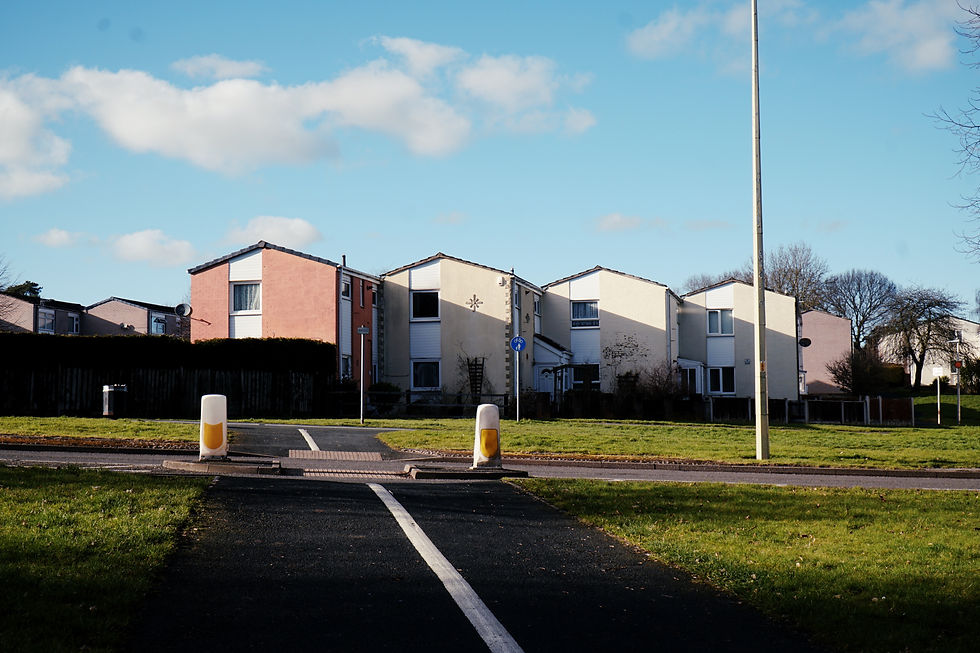
I’m circling the estate, on the perimeter road, tracking my prey. This is a Radburn estate, an idea imported from New Jersey, USA, originally designed for detached houses in a village setting into 1929, itself influenced by Ebenezer Howard and others. Here, translated into space restricted post-war Britain. Put simply the Radburn design separates cars and people, pushing vehicles to the outside edge (and the occasional access road) and thereby promoting community and companionship through the extensive use of internal footpaths, alleyways, subways and open common space.

It came fully loaded with big ambitions of health, happiness and modernity, which made it very popular with our new town planners. Not universally adopted in new towns, but an exemplary utopian design of the times.
The outer ring road feels immediately like a medieval moat put here to defend, keeping outsiders out. The designers intention was to restrict the motor traffic that would pass through the innards, the unintentional consequence was to give the estate a hard edge, segregating and preventing the blending of old and new. You know when you’re in the estate, the perimeter road cannot be avoided or perhaps, escaped from. What lies beyond is unclear, hidden behind the tree line. The footpath is inconsistent and I tread gingerly on the muddy kerb until I reach an inlet. The speed limit reduces, a scrawny cat scowls and the estate welcomes me in.

I push in to the belly of the beast, picking a road that takes me past garages and back gates, it’s an access route, not designed for the walker, only really meant for parking your car and unloading your kids.
‘No Parking, entrance in constant use’. ‘Don’t park here’. ‘Access required’.
The war of words, unfolding, not just on Radburn estates, but all across squeezed Britain. The problem here was made more acute from the start. On some estates, by design, it’s one driveway to every four houses. Not consistent with the car-led dreams of the future but necessary when building houses on mass and popular with utopian modernists.

Turning away I pass through a narrow gap in the houses that brings me to a row of white front doors, spaced out along a footpath, unkempt grass either side. An empty packet of salt and vinegar drifts past in the breeze, overtaking my leisurely pace. This is the centre piece idea of the scheme, and simultaneously it’s great undoing. No road at the front of your house, instead only a footpath.
This is what was meant to make Britain great again, a place for kids to play outside, together, whilst their parents kept an eye on them from the kitchen sink. A young urban explorers dream, subways, alleys and playgrounds, never more than a few minutes walk from your friends, routes with no danger from cars. Mums having a coffee on the front doorstep with their neighbour. Dad tinkering with his mid-life crisis sports car around the back.
It may have been a rose tinted notion, but for many of the new residents it was still something new, to be embraced. The kids soon came up with their own ways of making entertainment.
“There was games we used to play like hang and drop….. that was where you’d hang on the subway and drop about 10 feet to the path… and of course you were a chicken if you didn’t do it”
Transcript from interview with Al and Dave, Telford residents, in my Telford New Town documentary
For the adult population things were different. Social problems began to occur on the estates. The problem with so much common space is that it requires everyone to care equally for it to be successful. On a wider scale early residents regularly complained of a lack of facilities, little provision was made for local shops, community centres and schools. Limited public transport often meant it was very easy for the non-motorist to feel trapped by that perimeter road.
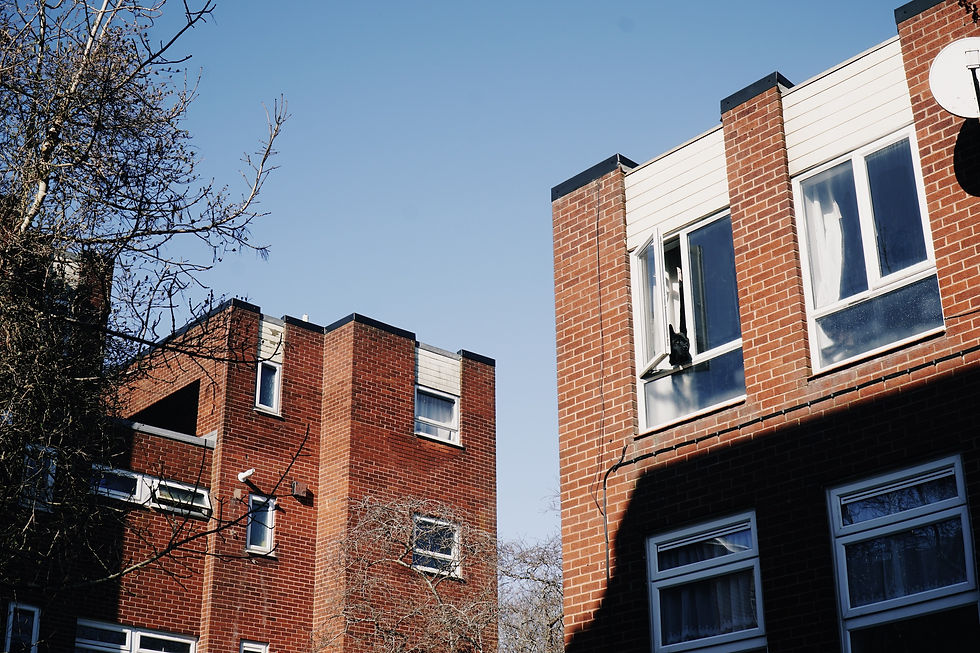
Those problems often came from budgetary constraints and labour shortages, housing the masses had to be done cheaply and efficiently with an often low-skilled workforce. A rationalised approach to construction was employed, using timber framing techniques with thin cladding. It may be low-budget, but the architecture is pleasant and successful, softer and more humanistic than the concrete that is so often associated with post-war buildings, whilst retaining the modernist straight lines and hard angles. Much more interesting than todays new-build, copy-cat, neo-traditional suburban vernacular.

Critics declare these estates a social experiment, played out by unsuspecting participants. Architects playing god, making places they wouldn’t be prepared to live in themselves. Even the architects themselves sometimes agree.
"Everything that could go wrong in a society went wrong.... It became the centre of drugs, it became the centre of violence and, eventually, the police refused to go into it. It was hell.”
Philip Cox (referring to a Radburn inspired design scheme in Villawood, Sydney).
In time the quiet footpaths and alleyways became claustrophobic, unsafe even, and there was significant problems with crime and disorder. Maintenance issues persisted too, leaking roofs, sound-proofing problems and no thermal insulation to speak of. On estates that were declared smokeless, electric heating was expensive. Councils said the residents were at fault for not understanding how to control the new radiators.
The Radburn estates remain, in one form or another, to fight another day, standing up for modernist ideals and utopian concepts. Many have experienced significant demolition, redesigning and rebuilding.

Despite what went wrong, the planning was consistently stringent and considered, throughout the growth of the later housing estates. The designers often sent in draft sketches only to receive notes back like:
“You can do better than that”
Lord Northfield, Telford Development Corporation
These buildings have a rhythm and patterns that please the eye, it’s successfully modernist, with clean lines, sharp edges and big windows. There’s an attractiveness and an attention to aesthetics that is not often felt in British housing projects. And yet they’ve not aged well. Maintenance budgets are rarely what they should be. A limited shelf life anyway, low resale value. Cash buyers only, non-traditional construction thins out the mortgage offers.
Still though, this is bold and beautiful housing, an attempt at something better. I eject myself at the far-side of the estate, back to the perimeter road, defender and concealer of what lies inside.


